Art Basel is coming up and I’m already feeling FOMO since I did not take any time to reach out to any galleries and market this art installation so it can have a home during the most famous art week of the year here. I sent out a few feelers to colleagues who are connected in the art world to see about getting placement but I haven’t gotten results yet. I feel like I’m always thinking I need a better reel for this project and perhaps it’s time I create one. That video recording of me dancing with the energy ball from the last dev log honestly looks better than most of the footage in any of the reels I’ve presented since the particle physics have improved so much lately. I’ll be thinking more about this over the course of the week but I’m running out of time and need to make moves.
Anyhow, I also decided I might as well get some dev work done. I started with an easy one-prompter, which was to fully move to the new input system, and I successfully avoided the rabbit hole that would stem from fixing a bug in the Unity CLI related to input presses not being read properly. I can do that. I can PR upstream another time when it isn’t after midnight.
Temporarily freed by not delving into that side quest, I prompted Claude for some advice on how to make the particles in the sphere remain more visible (so the sphere shape appears to stay intact even when the energy ball has a lot of motion). My best idea was to spawn particles inside the sphere when its velocity exceeded a certain number. I figured that changing the location of a few thousand particles wouldn’t be super noticeable and might end up making a real difference in visibility. Claude, of course, had a much better idea and it was so obvious that I can’t believe I didn’t think of it myself: carry particles with the ball. “In Update, before the attraction blocks, add the ball’s movement to every particle near the surface”. The agent also succinctly explained the root of the issue keeping the particles from staying near the ball, which I’d for so long failed to pinpoint but which was just as obvious: “The particles chase the ball with a capped speed (mainAttractionSpeed). Once the ball moves faster than that, they can’t catch up no matter how strong the forces are.” Duh. I always knew I couldn’t tweak mainAttractionSpeed, though, because it isn’t just a top limit for the SDF attractor speed—it also controls how quickly the particles move toward the ball from the hands. If you’re astute like me, though, it suddenly occurred to you, right after reading those last two sentences, that the actual simplest solution is to give a much higher attraction speed to particles that have already collided with the sphere. Not so fast. Doing that causes particles inside the sphere to move way too chaotically. Perhaps I could counter that with drag, but as far as I’m concerned that brings us right back to where we started, which is adding extra shit to make this work.
I let Claude do its thing, and the results are phenomenal.
I sweetened things even further by lowering the push force and increasing the drag on the sphere, which prevents it from moving as fast in the first place. I also had Claude implement one of its other ideas, which was to dim “straggler” particles, a.k.a. particles that have already collided with the sphere and moved far outside its radius due to motion.
One tiny bug the carry velocity revealed was a visible gap in the stream of particles travelling toward the sphere from the hands when the hands first open.
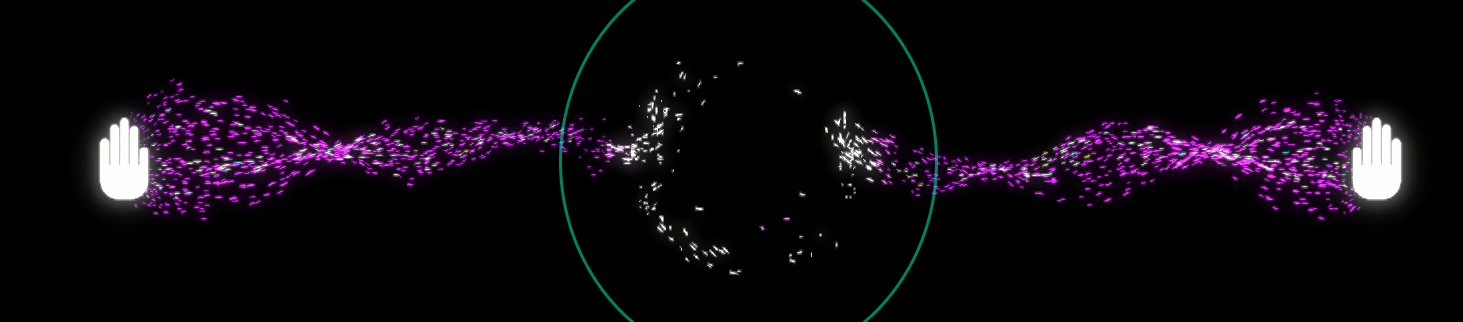
My agent successfully deflected my accusation that its carry code caused this bug by demonstrating that if I disabled tangential damping, the gap disappeared. It turned out the gap got caused by tangential damping’s fade-in range being too compact. Once I increased the space the damping used to ease in, the gap disappeared.
Super satisfied with my work today, although in truth I need to make a new reel and send it to some galleries. That’s the new top priority. On the dev side though, next up is to start playing with using the Kinect’s infrared stream instead of the color stream so the experience feels smoother. I wonder if I’ll still be able to color the infrared stream using color stream data. My graph has gotten absolutely insane by the way and I should probably test this project on my 4080 laptop to make sure that it can still handle the energy ball.
It’s way past my bedtime now. Goodnight!