Started my refactor of the graph today to move it away from any Age Over Lifetime blocks/nodes, which will allow me to abandon the rudimentary distance-based lifetime assigned at particle birth.
The agent suggested a very clever trick using an attribute I’d forgotten existed, hasCollisionEvent. By checking to see if hasCollisionEvent is true and hasCollided is false, I can get the exact moment in time when the particles collide and do stuff with it, such as triggering their fade-out. I didn’t even realize this before, but the fade-out was completely driven by size rather than alpha. Not a huge deal either way because I can use the same logic for both.
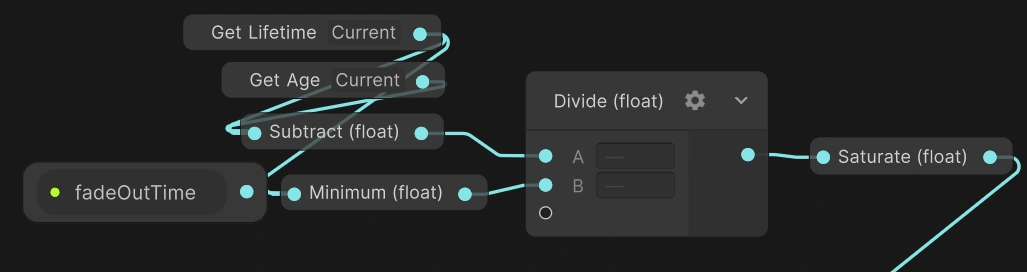
The agent flagged three other locations where Age over Lifetime is used, and two of those can be ignored as far as I can tell, with zero visible effects caused by changing a particle’s lifetime at the collision event. The one area I did need to refactor, however, was my coloring logic, where I set the particle color by sampling a gradient over its lifetime, which just barely passed the eye test because a particle’s lifetime was being determined by its distance from the energy sphere at its inception. I need a system based on particle distance from the sphere that also evolves with age.
Sometimes you get to a place that’s good enough, even though you know you can do better. That’s where I’ve gotten to with my new and improved color system—it’s late and I need to stop for my own well-being. I’m not sure yet how to make it so the energy ball is a bright color different from the rest of the particles. Claude says I need to use a Multiply Color block instead of a Blend Color, but I think it isn’t accounting for perceived brightness. If I multiply the color, I can retain some of the hue, but it still converges towards white the more I try to increase the perceived brightness. Maybe my earlier realization that I was never setting the particle alpha value was a clue—that what really counts when it comes to the perceived brightness of a particle is its size.